Category Archives: Uncategorized

Unbiased nutritional recommendations…

…are hard to come by.

In a recent newsletter P D Mangen cited an interesting study coming from NutriRECS, which does seem to be an organisation that is set up to give unbiased and decent nutritional advice. I like that.

The study that PD was using was a recent study that basically says its fine to continue to eat red meat, both processed and unprocessed. Phew!

Hopeful, I took a look at their other publications, but unfortunately the only other one that I thought was generally useful from a nutritional perspective was their study that took a look at the true effectiveness of various named and branded diets.

This study basically concluded that any diet was better than no diet for weight loss, and that either low carb or low fat were pretty much equally good. Low carb has slightly better results at 6 months and low fat at 12. But at the end of the day it is about choosing something you can stick to for life.

Calorie reductions versus occasional calorie elimination (fasting) wasn’t highlighted.

So this was just looking at the overall weight loss. But some people look to manage things other than weight. I’m interested in optimal body performance, strength and long life. Being the right weight is only part of the story. Insulin control seems to be pertinent too.

It is a shame that NutriRECS haven’t said anything about this aspect of nutrition.

There was one other article which deals with marketing of unhealthy food products to children. In another nobrainer conclusion it says that marketing of unhealthy food to children works! The children eat unhealthy food when they are exposed to adverts that show it.

So what other organisations are there one could trust to give decent nutritional advice? The Cochrane Organisation is well known for being a gold standard in this space. A quick look at their site for evidence and research on insulin resistance returns some interesting debunking if nothing else:

  • Zinc supplements won’t prevent diabetes if you already have insulin resistance
  • Fish oil is good for reducing triglyceride levels but have no impact on fasting blood glucose or HbA1c levels
  • Keeping to a treatment plan can improve blood glucose control. Losing weight, exercise and dietary changes are all part of that treatment plan (see * below)
  • Group based, patient centred educational programmes results in improved health outcomes for people with diabetes
  • Exercise improves glycaemic control, insulin response and triglyceride levels

* Isn’t it odd that the things we discuss in this blog for being super healthy are called a ‘treatment plan’ or ‘self-management’ when you have diabetes. Why not target and implement these behaviours when you are healthy so you never actually get diabetes in the first place?

The really interesting thing for me at least was what their findings on self monitoring of blood glucose levels (for people with diabetes) show:

Self monitoring might be effective in improving glycaemic control, but there was no evidence of improved fasting blood glucose levels; no evidence of improved well-being or generally improved impact on life.

My own personal experiment has shown that I wasn’t able to improve my fasting blood levels by monitoring over a 4 month period. Fail!

It is also helpful to think a bit more about the various things that Cochrane were reporting on that either were or were not affected:

  • Blood glucose control or Glycaemic control
  • Fasting Blood Glucose levels
  • HbA1c levels
  • Triglyceride levels
  • Insulin response

Really this just goes to show that it is quite difficult to sometimes figure out what effects changes have on the body, there are so many variables that one can monitor. It is also too easy to confuse one with the other. For example blood glucose levels and blood glucose control. It is possible to have high fasting blood glucose levels but really good glyceamic control. My own experiments have shown this quite effectively.

Conclusion?

Eat real food when you can, ignore what ‘experts’ tell you because they are probably wrong, prepare and cook your own food when you can, exercise when you can.

Sounds like the PD Mangen and Malcolm Kendrick diet and exercise plan are right to me.

Merchants of doubt

Worth a watch. Worth a read?

I watched this the other night. Entertaining and interesting to see how we are conned simply by big food saying ‘it’s not conclusive’.

Basically the film tells the story of how big corporations (big corp) manipulate society by sowing doubt and deflecting messages.

Let’s say you engage in a practice that you enjoy, but you are concerned it isn’t good for you.

Maybe that’s drinking alcohol. Maybe you are concerned that you drink too much and that it is going to kill you…

So what if you then do a bit of research and find out that it ‘isn’t conclusive’. That there is evidence for both good and bad, and that there is no one truth. That there is debate on the subject.

What are you going to do? You enjoy drinking. But you are worried. Do you stop drinking just in case? Or do you carry on and park that worry until there is something a bit more conclusive?

That is how big corp manipulates is all into doing what they want. They don’t care about your health. They will lie, cheat and steal your health away from you. To make a profit.

None of the big execs of tobacco were personally punished when it finally became clear that this is what big tobacco had been doing to us for years.

Well, big food, big pharma and big govt are doing the same to you, have been for 50 years, with your food.

So what to do? Weigh up the balance of probability. Listen to your instinct. Because at the end of the day if you are waking up with a hangover would you say that is good for you or bad for you?

Make your own decisions based on your own evidence.

Tryptophan FTW (it makes you feel good)…

Eat eggs, lots of eggs.

Tryptophan is quite a rare protein which is found in eggs, fish and poultry.

So why eggs? They are a complete food, and easy to cook with. You can even eat eggs raw. Try a couple in a pint of whole milk for a quick and nutritious egg shake.

So what is tryptophan? It is an essential amino acid. This means that the body needs it but cannot make it on its own. It has to be ingested in your food.

Why does the body need it? It is used as a precursor for seratonin amongst other things (melatonin and vitamin b3).

If you are low in seratonin is can make you feel bad, feel depressed and other bad mental things.

So before you go to the doctors and get prescribed some pills (that is pretty much all a doctor knows and is incentivised to do) think about whether you are getting enough protein, and the right type.

Remember that tryptophan isn’t in all sources of protein, so make sure to find out more about this essential protein and have a think about where you are getting yours from.

Introduce Yourself (Example Post)

This is an example post, originally published as part of Blogging University. Enroll in one of our ten programs, and start your blog right.

You’re going to publish a post today. Don’t worry about how your blog looks. Don’t worry if you haven’t given it a name yet, or you’re feeling overwhelmed. Just click the “New Post” button, and tell us why you’re here.

Why do this?

  • Because it gives new readers context. What are you about? Why should they read your blog?
  • Because it will help you focus your own ideas about your blog and what you’d like to do with it.

The post can be short or long, a personal intro to your life or a bloggy mission statement, a manifesto for the future or a simple outline of your the types of things you hope to publish.

To help you get started, here are a few questions:

  • Why are you blogging publicly, rather than keeping a personal journal?
  • What topics do you think you’ll write about?
  • Who would you love to connect with via your blog?
  • If you blog successfully throughout the next year, what would you hope to have accomplished?

You’re not locked into any of this; one of the wonderful things about blogs is how they constantly evolve as we learn, grow, and interact with one another — but it’s good to know where and why you started, and articulating your goals may just give you a few other post ideas.

Can’t think how to get started? Just write the first thing that pops into your head. Anne Lamott, author of a book on writing we love, says that you need to give yourself permission to write a “crappy first draft”. Anne makes a great point — just start writing, and worry about editing it later.

When you’re ready to publish, give your post three to five tags that describe your blog’s focus — writing, photography, fiction, parenting, food, cars, movies, sports, whatever. These tags will help others who care about your topics find you in the Reader. Make sure one of the tags is “zerotohero,” so other new bloggers can find you, too.

Health Monitoring – Blood Glucose – Part 7

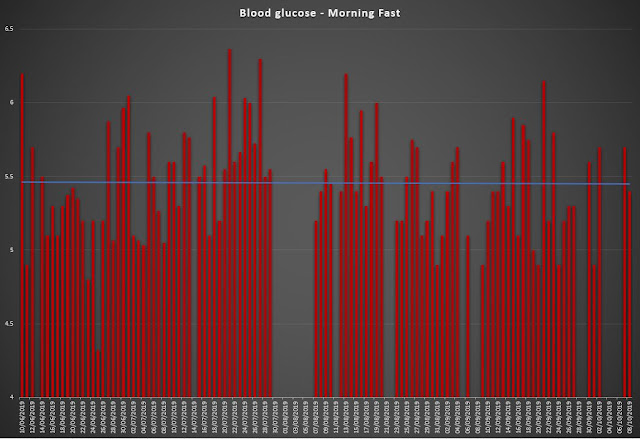
I’ve been monitoring my blood glucose morning levels for about 4 months now. Here is the data:

It shows that my fasting blood glucose does go up and down, some mornings it is high and others it is fine. Overall the average for the period is 5.45 which is normal. The average hasn’t changed for the period in question. I think that is probably a good thing. I’ve not been hyper vigilant on my inputs the whole time, I’ve just been living a normal healthy life generally.

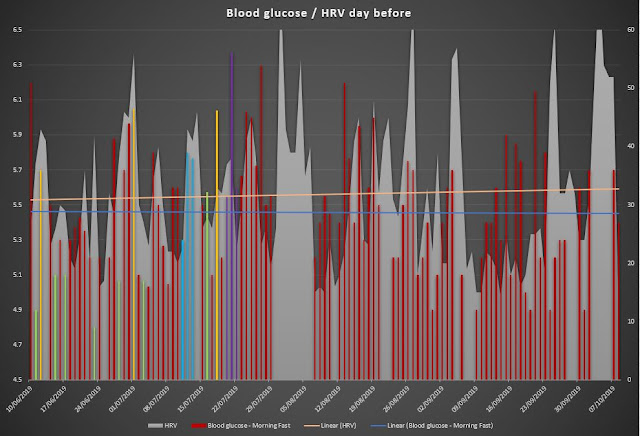
In a previous post I suggested a link between blood glucose and HRV the day before. Here is that graph updated:

Not such a strong correlation, although it is interesting to note that the holiday periods (the time when I’m not getting my blood tested) show high HRV. Generally I think this is a good thing as my holidays are very active.

So what to conclude. Not actually sure really. It seems that my diet isn’t really having that much impact on my fasting blood sugar levels, unless I fast. Keeping an eye on fasting blood sugar is probably a good thing. Whether I need to do it every day or not is debatable.

The fact that the high readings don’t appear in clusters is interesting. My readings are up one day and down the next. So it could show that anything that is affecting the reading is a short term actor. If I were able to see the effects over a longer term it would perhaps be easier to pinpoint what makes the reading higher on some days.